Showing posts with label pesticides. Show all posts

Wednesday, May 19, 2010

What Do Strawberries Have to Do with ADHD Kids?-Fooducate

A new study by US and Canadian scientists is linking ADHD to pesticide. Researchers found that kids with high levels of pesticide residue in their urine were more likely to suffer from the challenging attention deficit hyperactivity disorder. Unfortunately some of childrens’ favorite fruit are the most heavily sprayed with pesticides. Strawberries top the list.

What to do at the supermarket:

For some people, the solution is dead simple – buy organic. For most of us though, this is not an option, as the price is too prohibitive.

But if we reframe the financial consideration, and instead of focusing on just the high price of 2 lbs of fresh berries, think about our overall expenditure on food vs our spending on healthcare, things may even out.

If you’re a longtime reader of this blog, you know where to find hundreds of extra dollars to feed your organic frenzy – switching from soft drinks to tap water…

Just don’t give up fruit because you’re afraid of pesticides. Your kids are much better off with the nutritional benefits of conventional fruit than without.

Monday, June 15, 2009

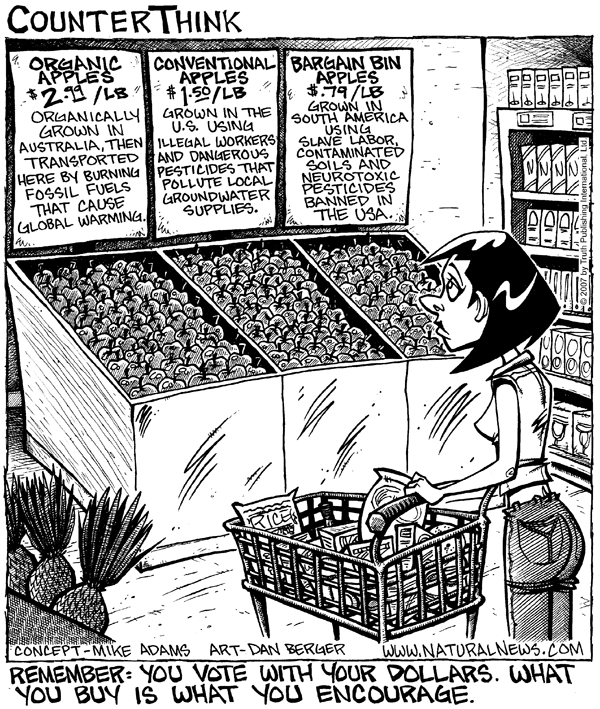
How to Buy Organic Apples (comic)


These days, it seems increasingly difficult to know what to shop for at the grocery store. Is organic always better than conventional? What if it's an "organic" product that's been flown half-way around the world, burning up fossil fuels that contribute to global warming? How do you decide what's better: A conventional apple grown locally with chemical pesticides, or an organic apple from another continent?

This cartoon depicts a common conundrum among consumers: How do you decide which grocery products are best for not just your own personal health, but also the health of the planet? It's a more complex decision than it might first seem. For one thing, much of the information necessary to make an informed decision simply isn't available to consumers. There is not determined enforcement of the rule, for example, that foods are accurately labeled with their country of origin. Nor is there any requirement to disclose which foods were grown with pesticides, herbicides or other chemicals banned in the United States (and U.K.) but still legal in other places like Central and South America.

If that last sentence surprises you, it should: not one in a hundred American consumers is aware that it is perfectly legal for U.S. chemical companies to export dangerous chemical pesticides (like DDT) that have been banned for use on crops in the United States. Those pesticides are sold to countries with lower environmental and health standards which turn around and use them on crops that are exported right back to the USA. So U.S. consumers end up eating produce grown with the very same pesticides banned in the United States, and it's all perfectly legal and openly accepted by the Food and Drug Administration and U.S. Department of Agriculture.

In the U.S., there's also the issue of so-called "illegal immigrants" (which I believe to be a strange term, since in my opinion there's no such thing as an "illegal" human being). On one hand, U.S. consumers demand cheap produce that can only be grown and harvested with the help of illegal immigrant labor. On the other hand, Americans grumble about too many Mexicans migrating into California, Arizona, New Mexico and Texas, claiming they are stealing jobs and bankruptcing cities and states. And yet, not surprisingly, when most consumers have a choice between a $3 apple grown on a farm that pays legal wages to U.S. workers and a $1 apple grown on a farm that pays "illegal" wages to an undocumented worker from Mexico, most Americans will choose the $1 apple (and in doing so, they are in fact continuing to vote for the very illegal immigration they claim to oppose).

Challenging to consumers

Making an informed produce purchasing decision at the grocery store, it turns out, is nearly impossible these days. There's no way to know where the food came from, what soils it was grown in, the immigration status of those who harvested it, and which chemicals were used on it. And to make matters worse, powerful food corporations are constantly trying to water down the definition of "organic" to include the agricultural use of obscene substances such as raw human sewage. (Fortunately, that was not ultimately allowed under the "organic" label, but the food companies tried to sneak it in!)

The only way to truly know where your food comes from is to know your local farmers. When you know the people growing your food, and you can meet them face to face, then you know what you're getting. That's why I'm a huge supporter of CSAs (Community Supported Agriculture), farmers' markets, backyard gardening and local food co-ops. Through organizations like these, consumers can maintain close relationships with the people who grow their food, and farmers are able to exercise far greater control over what they grow, how they grow it, and how much they get paid for it.

Large commercial food companies like ADM would prefer that farmers remain isolated from consumers. They want all the food processing to go through them first, where they set the prices and conditions that farmers are forced to accept. Other corporations have used intellectual property control over genetically modified seeds to threaten farmers who are refusing to adopt their pesticide-ready crop varieties. It's all part of a plan to control the global food supply -- an endeavor that inevitably destroys local farming as well as agricultural biodiversity (which leaves crops susceptible to future wipeouts from infectious disease).

Sure, these companies can produce a nice, round, shiny apple at the grocery store for an unbelievably low price, but at what cost to the world? The existence of that apple is based on numerous inputs that may be highly detrimental to the health of the planet as a whole: The burning of fossil fuels for farming and transportation, the use of chemical pesticides that wash downstream and poison aquatic ecosystems, the use of artificial fertilizers that lack real soil nutrition, the destruction of microbial life in agricultural soils, the loss of biodiversity and the subsequent decline in wildlife populations, and so on.

The history is all there

When you look at an apple, you're really looking at an historical account of everything that happened to bring you that apple. The whole story is written into that apple. There's the intention of the people involved with producing that apple, the health of the soils, the use of chemicals (or not) on the apple, the impact on the environment, and much more.

An organic, locally-farmed apple from a small family farm tells a very different story: Respect for nature, positive intention, healthful soils, humility in nature, connection with plants and animals, biodiversity, minimal use of fossil fuels, and so on. This is the kind of apple I'd like to eat... how about you?

Now here's the real kicker in all this: When you eat an apple, you absorb and assimilate the story that went into creating that apple! So eating an organic, locally-grown, consciously-harvested apple gives you not only nourishment and biochemical nutrition, it also gives you the positive energy of abundance, humility, harmony and happiness. A conventionally-grown apple, on the other hand, is more likely to give you the story of greed, desperation, depletion, fear and disease. Is that the energy you want circulating in your veins?

An apple, you see, is made of much more than its chemical constituents. All fruits and vegetables have water, and water stores emotional energy, passing it on to those who consume the water. Since an apple is probably something like 75% water by volume, eating an apple is actually an exercise in chewing mostly on water.

Aren't you curious to know what kind of energy and intention is in that water? You should be. Because beyond the vitamins, minerals and phytonutrients in the apple, the water impacts your body, mind and spirit more than anything else. And one of the reasons we see so much obesity in America today is because people are eating empty, lifeless food products that provide only calories but no energetic nourishment. The food is mostly an empty shell, lifeless and devoid of positive vibration (and then they cook it, irradiate it and process it even more to give it shelf life!).

For the most part, the food isn't being grown, harvested and sold at a high enough vibration to end the cravings human beings have for nourishment at all levels: physical, emotional and spiritual. The food being sold today is missing something, and if you want complete food that's nourishing at all levels, I strongly recommend you grow it yourself or work with local farmers who you know are passionate about cooperating with nature to maximize abundance for themselves and those around them.

Saturday, February 21, 2009

Two Great Reasons to Buy Organic Foods

Two Great Reasons to Buy Organic Foods
by Sue Gilbert, M.S., Nutritionist

Why should you consider buying organic produce and foods? Consider your health and the environment's.

Health Considerations

Pesticides are poisons, designed to kill living things, and the accumulation of residues is greater on conventional foods than on organic ones. Studies suggest that low-level exposure to pesticides over several years can cause health problems. Pesticide-related illnesses among farm workers who handle these toxics are well documented. Immediate problems include lung and eye irritation, nausea and short-term nerve damage. Long-term risks include cancer and Lou Gehrig's disease.

Most of the commonly used manmade pesticides are potential carcinogens. Pesticides are also endocrine disrupters that mimic or interfere with hormones. The effect on our bodies is the topic of studies now underway. A 1987 National Academy of Science report suggested that many common pesticides can cause birth defects, cancer and nerve damage, as well as disrupting the immune system.

One of the most compelling reasons to buy organic foods is for the health of your children. Their exposure to pesticides is greater than an adult's. Children eat more fruits and vegetables relative to their body weight. Their diet is less varied -- so they may consume more of one pesticide than others, allowing it to accumulate to toxic levels. Because children are exposed to these chemicals early in their life, when their detoxification system isn't fully developed, they have more years to accumulate chemicals in their body tissue. A report released by the Environmental Working Group, "Pesticides in Children's Food," concluded that the largest contribution to a person's lifetime risk of cancer from pesticide residues occurs during childhood.

Environmental Concerns

Although human health risks are still not proven, and nutritional benefits are uncertain, there is no doubt that conventional farming methods damage the environment. In 1995, U.S. farmers applied 566 million pounds of pesticides to food crops and growing fields. Much of it ends up in your drinking water and in the water used by fish and animals. A summer, 1997, U.S. Geological Survey found at least one pesticide in half of the 5,000 water samples it took from rivers and nearly all the samples it took from wells.

Unlike organic farming, industrialized farming results in topsoil erosion. Conventional farming is also leading to the development of resistant strains of insects and pests. The synthetic chemicals applied to the soil are persistent, often remaining in the environment for years and putting us at risk for decades to come. As conventional farmers rely on limited varieties of crops, nutritional diversity declines and there is a greater risk of total crop damage from blight or disease.

Friday, August 15, 2008

Ingredients in Cigarettes

from tobacco.org 599 ingredients the tobacco manufacturers add to their cigarettes.


Cigarette smoke contains over 4,000 chemicals, including 43 known cancer-causing (carcinogenic) compounds and 400 other toxins. These include nicotine, tar, and carbon monoxide, as well as formaldehyde, ammonia, hydrogen cyanide, arsenic, and DDT.
Nicotine is highly addictive. Smoke containing nicotine is inhaled into the lungs, and the nicotine reaches your brain in just six seconds.
Nicotine in small doses acts as a stimulant to the brain. In large doses, it's a depressant, inhibiting the flow of signals between nerve cells. In even larger doses, it's a lethal poison, affecting the heart, blood vessels, and hormones. Nicotine in the bloodstream acts to make the smoker feel calm.
As a cigarette is smoked, the amount of tar inhaled into the lungs increases, and the last puff contains more than twice as much tar as the first puff. Carbon monoxide makes it harder for red blood cells to carry oxygen throughout the body. Tar is a mixture of substances that together form a sticky mass in the lungs.
Most of the chemicals inhaled in cigarette smoke stay in the lungs. The more you inhale, the better it feels—and the greater the damage to your lungs.

another cigarette article by:
Lowell Kleinman, M.D., and Deborah Messina-Kleinman, M.P.H.

Cigarette flavors have gone through many changes since cigarettes were first made. Initially, cigarettes were unfiltered, allowing the full "flavor" of the tar to come through. As the public became concerned about the health effects of smoking, filters were added. While this helped alleviate the public's fears, the result was a cigarette that tasted too bitter.

Filters Don't Work

Filters do not remove enough tar to make cigarettes less dangerous. They are just a marketing ploy to trick you into thinking you are smoking a safer cigarette.
The solution to the bitter-tasting cigarette was easy -- have some chemists add taste-improving chemicals to the tobacco. Unfortunately, some of these chemicals also cause cancer.
But not all of the chemicals in your cigarettes are there for taste enhancement. For example, a chemical very similar to rocket fuel helps keep the tip of the cigarette burning at an extremely hot temperature. This allows the nicotine in tobacco to turn into a vapor so your lungs can absorb it more easily.

Toilet Bowl Cleaner?

Most people prefer to use ammonia for things such as cleaning windows and toilet bowls. You may be surprised to learn that the tobacco industry has found some additional uses for this household product. By adding ammonia to your cigarettes, nicotine in its vapor form can be absorbed through your lungs more quickly. This, in turn, means your brain can get a higher dose of nicotine with each puff.

The complete list of chemicals added to your cigarettes is too long to list here.
Here are some examples that will surprise you:
Fungicides and pesticides -- Cause many types of cancers and birth defects.
Cadmium -- Linked to lung and prostate cancer.
Benzene -- Linked to leukemia.
Formaldehyde -- Linked to lung cancer.
Nickel -- Causes increased susceptibility to lung infections.
If you are angry that so many things have been added to the cigarettes you enjoy so much, you should be. Many of these chemicals were added to make you better able to tolerate toxic amounts of cigarette smoke. They were added without regard to your health and with the intent to keep you addicted. As the tobacco industry saying goes, "An addicted customer is a customer for life, no matter how short that life is."
Make sure that you have the last laugh. Regardless of the countless chemicals in your cigarettes, quitting is always your option.

Ask us how our all natural quit-smoking program can help you quit and regain your optimal health potential. Call 630-789-8080 or email us.

Monday, August 4, 2008

Coffee

Although coffee is one of the most heavily researched commodities and studies have spanned decades, there is still much controversy surrounding its effects on health. Study after study is performed--often with conflicting results--and it seems there is always a new study out to discount the last one.

For example, one 2004 study found that drinking coffee disrupted short-term word recall. This was promptly followed up by research published the following year, showing that the equivalent of two cups of coffee could improve short-term memory, prioritizing information efficiently, planning new tasks, and dealing with stored information.

I wonder who paid for the latter research? Hmmm.

Should You Drink Coffee?

It appears that drinking coffee may interfere with your body's ability to keep homocysteine and cholesterol levels in check, most likely by inhibiting the action of the vitamins folate, B12 or B6. Coffee has been previously associated with increased risk of stroke and rheumatoid arthritis. Studies have also shown that caffeine in coffee can raise blood pressure and levels of stress hormones, and if consumed in large quantities it can lead to heart palpitations, jitters and nervousness.

With that said, coffee is clearly not the healthiest liquid to drink – your best choice is pure water -- but coffee is still far less dangerous than fruit juice or soda.
While I do believe that eliminating, or at the very least limiting, coffee should be one of your goals. You'll definitely want to eliminate soda and fruit juice from your beverage list first.

There are, however, some important facets of coffee that you should know before you have your next morning cup.

The Dangers of Caffeine During Pregnancy

Pregnant women should NEVER drink coffee.

Caffeine is a stimulant drug that easily passes through the placenta to your developing fetus and is also transferred through breast milk.
During pregnancy and in infants, the half-life of caffeine is increased, which means that it will stay in your body, and your infant's body, longer. Moreover, fetuses have no ability to detoxify caffeine.
Research suggests that drinking more than 300 mg of coffee daily, or the equivalent of two to three 8-ounce cups, may increase the risk of miscarriage, birth defects such as cleft palate, and low birth weight. But as I mentioned above, I don't believe that ANY amount coffee is safe when you're pregnant.
Even with moderate caffeine intake, when the woman experiences no effects, studies have found changes in both the mother's and the fetal heart rate and blood pressure. Preliminary studies also suggest that drinking four cups of coffee or more per day may put the infant at an increased risk of sudden infant death syndrome (SIDS).
Caffeine may also make it more difficult for women to maintain necessary levels of iron and calcium, which are especially important during pregnancy.

Would you like your coffee with cream and DDT?

There Probably Are Pesticides in Your Java. Coffee also has the issue of pesticide contamination, which is particularly harmful during pregnancy.

Coffee is usually not grown in the United States and we therefore have no control over which and how many pesticides are sprayed on coffee crops. And coffee is a heavily sprayed crop, so drinking coffee is likely to expose you to a dose of pesticides with each cup.

Pesticides have been associated with a number of health problems such as:
Prostate cancer and other cancers
Parkinson's Disease
Miscarriages
Aside from any pesticide residues that make it into your brew, there's also the issue of whether buying coffees grown with the help of potentially harmful chemicals contributes to the destruction of the environment and threatens the health of poor coffee farm workers.
If you choose to drink coffee, drinking organic coffee will hopefully reduce or eliminate your exposure to toxic herbicides, pesticides and fertilizers, and would be a more environmentally conscientious choice. The only drawback is that many of the 45 countries where coffee is produced have less control and monitoring for compliance to organic practices.

Avoid Coffee if You Have Certain Health Issues

Since coffee is a stimulant it will only worsen symptoms of insomnia and anxiety, and should definitely be avoided if you're already suffering from either. People with panic or anxiety disorders may find that they are especially sensitive to caffeine and may find that even a small amount of the stimulant exacerbates their symptoms.
Similarly, the caffeine will linger in your body for hours after you drink it, so it might keep you up at night even if you drink it long before bedtime.

-Personal experience: I drank an iced coffee this month, because I was tired. I only drink coffee about once per month, if that. Well, at 1:30 pm I drank, I was fine. By 6pm I was dry heaving. I know it was from the coffee. My Lebanese friends used give me strong imported Lebanese coffee to drink because we were studying and I still had no effects from the caffeine. It was only until the past efew years that I actually developed the "normal" caffeine drug effects.

For those with high blood pressure, a general rule is that the more caffeine you drink in a day, the higher your blood pressure will be. So if you are already at the higher end of the scales, drinking coffee will only increase your blood pressure further.

Also Protein Nutritional Types do not do well with caffeine and should only consume coffee or tea in small quantities, and not in the late afternoon or evening, as it will likely keep them up. (However this can be a good thing if you are using coffee as a drug for jet lag).

How to Wean Yourself off Coffee

If you try to stop drinking coffee "cold turkey" you will likely experience symptoms of withdrawal. According to one study, the more caffeine you use, the worse your withdrawal symptoms will be. This is because even small amounts of caffeine, such as one standard cup of coffee a day, can create an addiction. For those who consume it regularly, cutting even the smallest amount of caffeine could result in a range of withdrawal symptoms such as:

Headache
Fatigue or drowsiness
Depression and irritability
Lack of concentration
Flu-like symptoms such as nausea and muscle pain

This can be avoided by cutting down the amount you drink gradually over a period of days, or even weeks. It's also important to drink plenty of water during the process in order to keep your body well hydrated.

If you find that you miss your morning coffee-drinking ritual, replace it with a new tradition that will also boost your health and energy. Vegetable juice makes a great coffee replacement. It will give you the energy boost that you're looking for in the morning without the negative effects of caffeine.

While you're in the process of weaning yourself off coffee, here are some tips to reduce the chance of harmful effects until you can completely eliminate it:

Use organic coffee. As mentioned above, coffee is a heavily sprayed crop, so drinking organic coffee might reduce or eliminate your exposure to toxic herbicides, pesticides and fertilizers. It will also help the people working in the coffee fields, as they will be exposed to fewer pesticides as well.

Try "Swiss Water Process" decaf. If you are going to drink decaffeinated coffee, be sure that it uses a non-chemical based method of decaffeination. The "Swiss Water Process" is a patented method and is the best choice. Most of the major brands are chemically decaffeinated, even if it says "naturally decaffeinated" right on the container. If you are unsure of the methods, contact the manufacturer.
Avoid sugar and milk. These are actually much worse for you than the coffee itself. Don't compound the detrimental health effects by adding milk or sugar to your coffee.

Only use unbleached filters. If you use a "drip" coffee maker, be sure to use non-bleached filters. The bright white ones, which most people use, are chlorine bleached and some of this chlorine will be extracted from the filter during the brewing process.
