
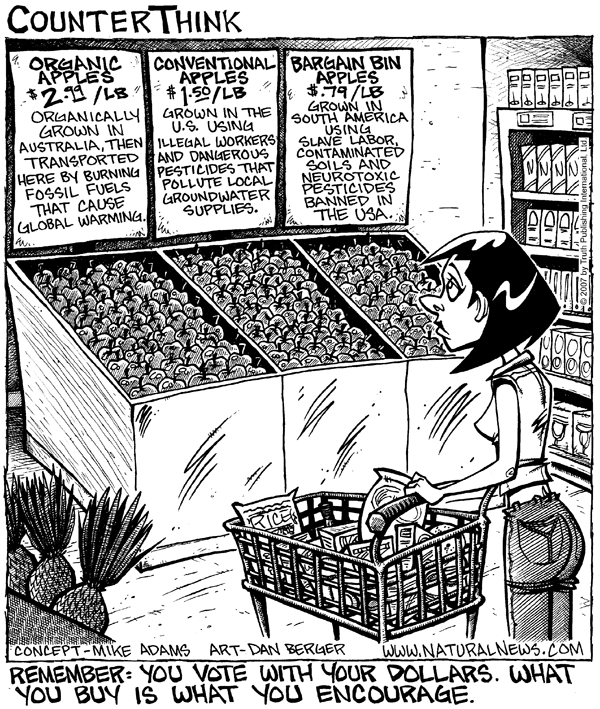
These days, it seems increasingly difficult to know what to shop for at the grocery store. Is organic always better than conventional? What if it's an "organic" product that's been flown half-way around the world, burning up fossil fuels that contribute to global warming? How do you decide what's better: A conventional apple grown locally with chemical pesticides, or an organic apple from another continent?
This cartoon depicts a common conundrum among consumers: How do you decide which grocery products are best for not just your own personal health, but also the health of the planet? It's a more complex decision than it might first seem. For one thing, much of the information necessary to make an informed decision simply isn't available to consumers. There is not determined enforcement of the rule, for example, that foods are accurately labeled with their country of origin. Nor is there any requirement to disclose which foods were grown with pesticides, herbicides or other chemicals banned in the United States (and U.K.) but still legal in other places like Central and South America.
If that last sentence surprises you, it should: not one in a hundred American consumers is aware that it is perfectly legal for U.S. chemical companies to export dangerous chemical pesticides (like DDT) that have been banned for use on crops in the United States. Those pesticides are sold to countries with lower environmental and health standards which turn around and use them on crops that are exported right back to the USA. So U.S. consumers end up eating produce grown with the very same pesticides banned in the United States, and it's all perfectly legal and openly accepted by the Food and Drug Administration and U.S. Department of Agriculture.
In the U.S., there's also the issue of so-called "illegal immigrants" (which I believe to be a strange term, since in my opinion there's no such thing as an "illegal" human being). On one hand, U.S. consumers demand cheap produce that can only be grown and harvested with the help of illegal immigrant labor. On the other hand, Americans grumble about too many Mexicans migrating into California, Arizona, New Mexico and Texas, claiming they are stealing jobs and bankruptcing cities and states. And yet, not surprisingly, when most consumers have a choice between a $3 apple grown on a farm that pays legal wages to U.S. workers and a $1 apple grown on a farm that pays "illegal" wages to an undocumented worker from Mexico, most Americans will choose the $1 apple (and in doing so, they are in fact continuing to vote for the very illegal immigration they claim to oppose).
Challenging to consumers
Making an informed produce purchasing decision at the grocery store, it turns out, is nearly impossible these days. There's no way to know where the food came from, what soils it was grown in, the immigration status of those who harvested it, and which chemicals were used on it. And to make matters worse, powerful food corporations are constantly trying to water down the definition of "organic" to include the agricultural use of obscene substances such as raw human sewage. (Fortunately, that was not ultimately allowed under the "organic" label, but the food companies tried to sneak it in!)The only way to truly know where your food comes from is to know your local farmers. When you know the people growing your food, and you can meet them face to face, then you know what you're getting. That's why I'm a huge supporter of CSAs (Community Supported Agriculture), farmers' markets, backyard gardening and local food co-ops. Through organizations like these, consumers can maintain close relationships with the people who grow their food, and farmers are able to exercise far greater control over what they grow, how they grow it, and how much they get paid for it.
Large commercial food companies like ADM would prefer that farmers remain isolated from consumers. They want all the food processing to go through them first, where they set the prices and conditions that farmers are forced to accept. Other corporations have used intellectual property control over genetically modified seeds to threaten farmers who are refusing to adopt their pesticide-ready crop varieties. It's all part of a plan to control the global food supply -- an endeavor that inevitably destroys local farming as well as agricultural biodiversity (which leaves crops susceptible to future wipeouts from infectious disease).
Sure, these companies can produce a nice, round, shiny apple at the grocery store for an unbelievably low price, but at what cost to the world? The existence of that apple is based on numerous inputs that may be highly detrimental to the health of the planet as a whole: The burning of fossil fuels for farming and transportation, the use of chemical pesticides that wash downstream and poison aquatic ecosystems, the use of artificial fertilizers that lack real soil nutrition, the destruction of microbial life in agricultural soils, the loss of biodiversity and the subsequent decline in wildlife populations, and so on.
The history is all there
When you look at an apple, you're really looking at an historical account of everything that happened to bring you that apple. The whole story is written into that apple. There's the intention of the people involved with producing that apple, the health of the soils, the use of chemicals (or not) on the apple, the impact on the environment, and much more.An organic, locally-farmed apple from a small family farm tells a very different story: Respect for nature, positive intention, healthful soils, humility in nature, connection with plants and animals, biodiversity, minimal use of fossil fuels, and so on. This is the kind of apple I'd like to eat... how about you?
Now here's the real kicker in all this: When you eat an apple, you absorb and assimilate the story that went into creating that apple! So eating an organic, locally-grown, consciously-harvested apple gives you not only nourishment and biochemical nutrition, it also gives you the positive energy of abundance, humility, harmony and happiness. A conventionally-grown apple, on the other hand, is more likely to give you the story of greed, desperation, depletion, fear and disease. Is that the energy you want circulating in your veins?
An apple, you see, is made of much more than its chemical constituents. All fruits and vegetables have water, and water stores emotional energy, passing it on to those who consume the water. Since an apple is probably something like 75% water by volume, eating an apple is actually an exercise in chewing mostly on water.
Aren't you curious to know what kind of energy and intention is in that water? You should be. Because beyond the vitamins, minerals and phytonutrients in the apple, the water impacts your body, mind and spirit more than anything else. And one of the reasons we see so much obesity in America today is because people are eating empty, lifeless food products that provide only calories but no energetic nourishment. The food is mostly an empty shell, lifeless and devoid of positive vibration (and then they cook it, irradiate it and process it even more to give it shelf life!).
For the most part, the food isn't being grown, harvested and sold at a high enough vibration to end the cravings human beings have for nourishment at all levels: physical, emotional and spiritual. The food being sold today is missing something, and if you want complete food that's nourishing at all levels, I strongly recommend you grow it yourself or work with local farmers who you know are passionate about cooperating with nature to maximize abundance for themselves and those around them.


 Posts
Posts

